The Lethal Consequences of Never Leaving Money on the Table
In 1973, Ford created the Pinto, only to realize that its fuel tank design posed a severe risk of explosion in rear-end collisions. Instead of recalling the cars immediately, Ford executives wrote what became known as the infamous “Pinto Memo.” This document coldly compared the cost of paying damages for an expected 180 deaths and 180 injuries — about $49.5 million — to the $137 million needed for a recall.
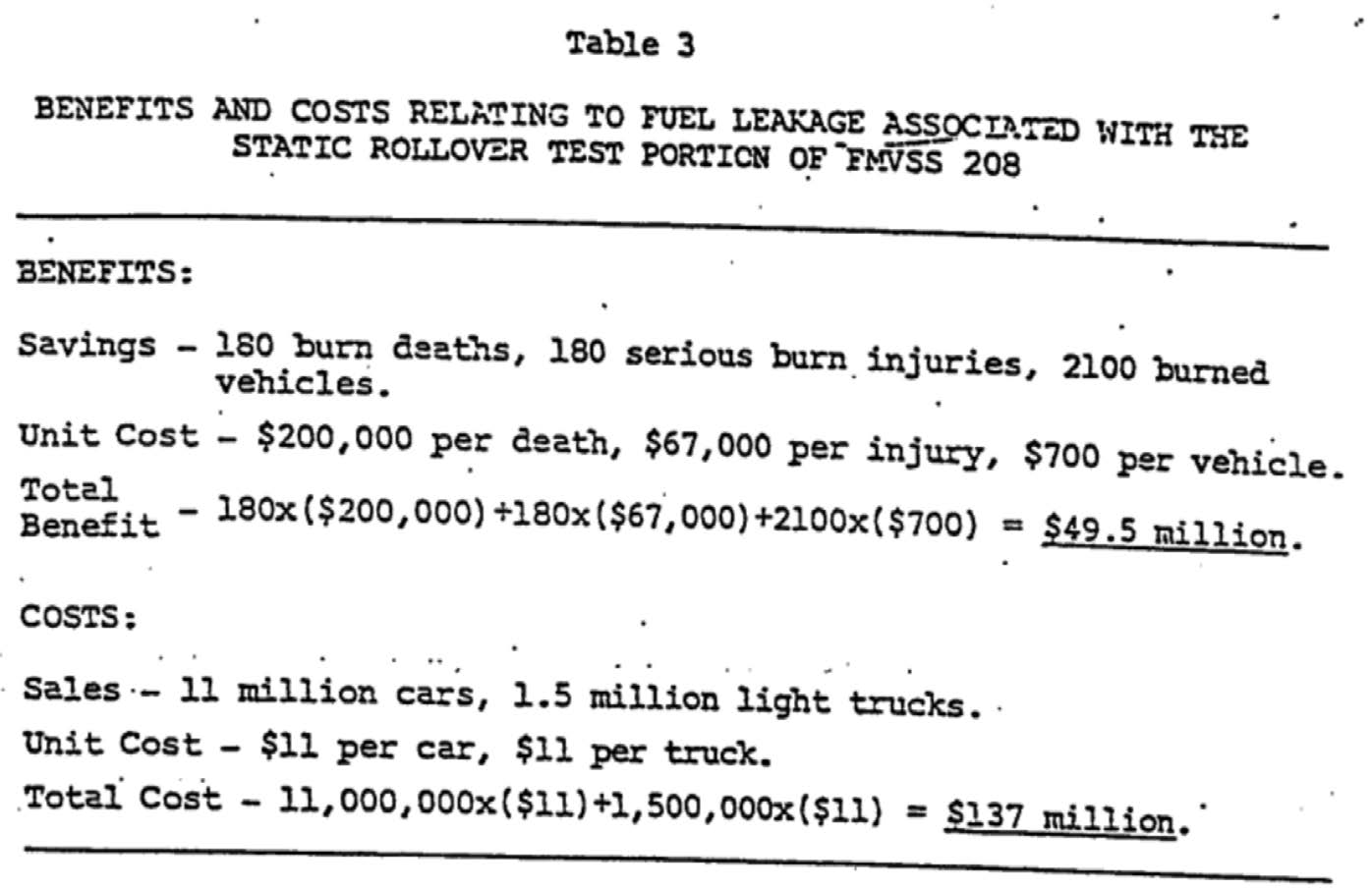
Figure 5: An extract from the original Pinto Memo. Ford used this internal memo to justify higher profits at the cost of human life.
For context, in 1973 Ford made a $1.7 billion profit and felt that a mere profit of $1,563,000,000 was unacceptable, even if that meant killing an expected 180 human beings and injuring an additional 180 people. Stunningly, the court only required Ford to pay $3.5 million in punitive damages.
The executives at Ford were probably competent executives who achieved their budgets and accomplished their quarterly goals. They were paid well, and when they traveled, they no doubt would have flown business class and stayed at five-star hotels. Yet, beneath their seemingly respectable appearance, there was a callous emptiness inside.
How can a human being become so disconnected from their work that they prioritize company profits over the sanctity of human life? It is staggering to contemplate how these Ford executives reached this state of dysfunction. Perhaps the greatest lesson is that cold logic can create an amorality nothing short of lethal.
While you may justifiably scoff at the Pinto Memo, it’s more challenging to ask, “When I was faced with two opportunities, have I ever used money alone to prioritize one opportunity over the other?” If so, you have made the same error as these Ford executives. While you probably didn’t harm others, you likely harmed yourself.
In business, you often hear, “Never leave money on the table.” In fact, the opposite is true. You always want to leave money on the table. Never make optimizing your financial return your top priority because the cost of doing so is disastrously high. Never enter into a profitable business partnership with someone you don’t like. Never work so hard to earn money that it comes at the expense of your health. Never do work that makes you a fortune but leaves you feeling empty and unfulfilled. Be extremely careful before you sign up for any lucrative project that may negatively affect your autonomy, creative expression, or relationships. Money has been sold to us as the ultimate cure to all our problems, but in reality, it is merely a blunt tool useful for facilitating interesting experiences. As soon as you let a financial windfall make you feel more significant, you have missed the point entirely.
The notion, “I want money so that life is easy,” is true insofar as money is required to cover essential needs. However, once essential needs are covered, this notion becomes flawed as you realize that money fails to make many other aspects of life easy.
This article is an excerpt from Chapter 9 of Choose Your Work
Footnotes
You always want to leave money on the table: Even if your goal is to maximize profits, you still want to leave money on the table. As billionaire property investor Sam Zell stated in his excellent book Am I Being Too Subtle?, “In any negotiation I believe in leaving a little bit on the table. And in any relationship I believe in sharing the stakes. I’ve been doing deals with many of the same people for decades because the goal is for us to all come out ahead. And many of my employees have been with me for twenty or thirty years or more because if I do well, they do well.” Sam Zell, Am I Being Too Subtle? Straight Talk from a Business Rebel (New York: Portfolio, 2017), 10.
Never make optimizing your financial return your top priority because the cost of doing so is disastrously high: Longitudinal studies have confirmed that well-being improves as less importance is placed on materialistic goals and values. See Tim Kasser et al., “Changes in Materialism, Changes in Psychological Well-Being: Evidence from Three Longitudinal Studies and an Intervention Experiment,” Motivation and Emotion 38, no. 1 (2014): 1–22, https://doi.org/10.1007/s11031-013-9371-4.
About the Author
Dan Dobos writes about decision making, personal growth, human potential, fulfillment and helping people choose the work that they are meant to do. He is the author of Choose Your Work.